



My Story by Melanie Phipps

The 15th of May each year is PDA Day, an awareness day for Pathological Demand Avoidance which is currently understood to be a distinct profile on the autism spectrum. This profile is characterised by an anxiety driven need to avoid everyday demands and expectations and maintain control. Raising understanding and awareness is very important to me because without it, so many children continue to be inadequately and inappropriately supported because the approaches that work well in supporting PDAers are very different to what are considered typical parenting strategies or strategies that might work well for more typically presenting autism.
Here is my story about how I came to completely change my approach to parenting, which may have happened so much sooner had my understanding and awareness of PDA come at an earlier point in our journey.

Picture source: Pexels
I was pretty sure I’d got parenting nailed…… I mean don’t get me wrong, parenting wasn’t anywhere close to how I had imagined it, but generally my eldest son was a pretty straightforward baby and toddler. This was during the era of Gina Ford, and Supernanny which firmly cemented in place my preconceived ideas around parenting of routine, rewards, consequences, naughty steps and a no nonsense approach. What embedded my beliefs around parenting even more was the fact that they worked, they worked really well!
So when N came along and settled very easily into our already established routine I really felt like I was winning at life. Boy, was I in for the shock of my life!
I lived in this fairly blissful state for about a year, until around the time N started walking and talking and gaining a little influence over his life. Fairly suddenly and spectacularly it felt like everything was falling apart, and that everything I knew stopped working. I remember it feeling like a whirlwind where suddenly everything seemed to have become very challenging. I was working 3 days a week at the time, and just getting out the door in the mornings felt like I had done 5 rounds in the boxing ring. If you want to read more about our early experiences head over to this blog post here. What was this madness I was experiencing? I was dealing with extreme challenging behaviour, an increasingly aggressive child, and no ability to discipline and teach this child what he was expected to do. Of course society and professionals encourage you to discipline more, set firmer boundaries and suggest parenting courses, but the more I did this the worse and worse things got. By the age of 7 years old we were at crisis point. It wasn’t long after that someone said to me the words that changed our lives which were “have you heard of PDA?”
I spent the next weeks and months researching, joining support groups and asking questions. I was surprised and relieved to find something different to what I had experienced before, and suggestions that actually made sense when it came to my child. They were suggestions that really got me questioning my values and expectations as a parent, which helped me start to see a different way. At some point along our journey we also came across the Ross Greene – “Lives in the Balance” videos on YouTube which I remember being the key point at which everything made sense and slotted into place. I still watch them every now and then even though I know the videos well, just to remind myself of that moment and re-experience the emotions I felt at the time.
So let’s get down to business and talk about what does and doesn’t work with PDA
With PDA it’s not so much a set of strategies, but more an approach with a toolbox full of ideas, knowledge and understanding that you can draw on at any given moment. What works one day might not work the next day or next week, but it might work again another time just when you feel you have run out of options.
It’s probably easier to begin with some ideas about what doesn’t work which I have summarised in the visual below.
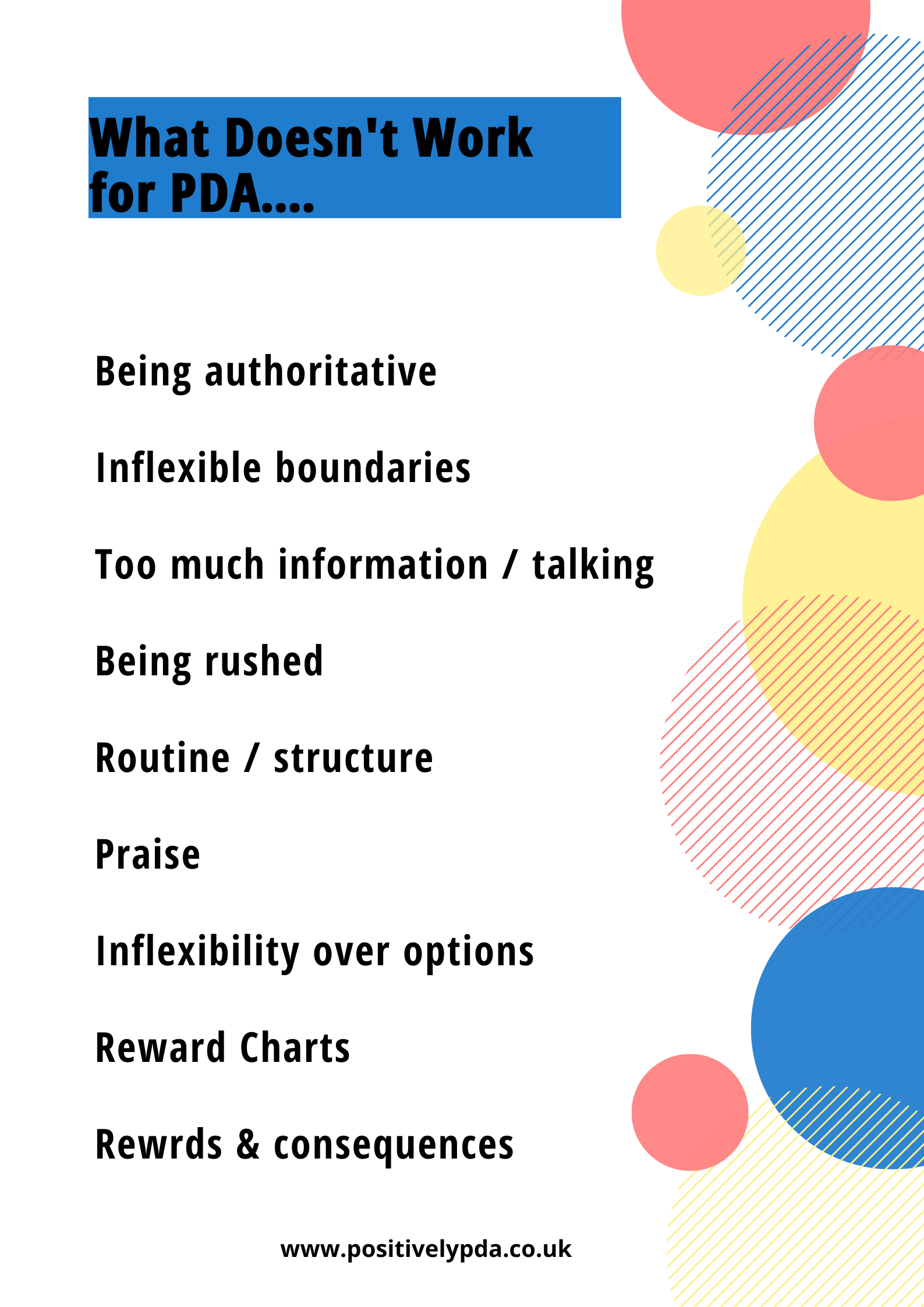
So now we have looked at what doesn’t work, let’s look at some of the helpful approaches:
LOWERING DEMANDS AND EXPECTATIONS
Get rid of what you can and only keep what’s necessary. At times dropping ALL demands might be necessary. You can receive the Managing Demands and Expectations Resource Pack completely free here.
PICKING BATTLES
Ask yourself does this really matter in the grand scheme of things, is it worth picking this battle?
LETTING GO
Let go of the idea that you are giving in or letting them get away with things
BEING MORE FLEXIBLE
Meeting rigid inflexible thinking with rigid inflexible thinking gets us nowhere.
UNDERSTAND WHY
Why is this important to the child, can you put yourself in their perspective?
CHANGING LANGUAGE
Declarative language can be helpful, being less direct with requests, “I wonder if….” etc
STOP SAYING NO
There are tons of ways to say no without saying “NO!”, and if you can say yes, say “YES!” (Find out how to stop saying “No!” and start saying “yes” more, here)
THROW OUT THE PARENTING MANUAL
Typical parenting techniques don’t tend to work and often make things worse
TRY TO RESOLVE THINGS COLLABORATIVELY
Allow all to give their perspective, respect and try to find a way that works for all
STAY OUTWARDLY CALM EVEN WHEN YOU’RE READY TO EXPLODE YOURSELF
This can be hard but so important so we don’t add fuel to the fire.
OFFER LIMITED CHOICE
Too little choice takes away the control that they need, too much choice can feel overwhelming. Try and figure out what works well for your child. Usually 2-3 choices, or choice within an expectation (e.g. would you like your bath before or after dinner/tonight or tomorrow night?)
THINK ABOUT TRANSITION
Make the activity they are transitioning to a better offer or more appealing than the last one. Give warnings but be flexible around the deadline to take into account things that are important to the child (Like getting to a save point in the game before turning off)
SUPPORT SENSORY NEEDS
Individuals can be sensory seekers or sensory avoiders. Learn about their sensory needs and offer sensory equipment and activities
REDUCE TIME PRESSURE
Time can be a massive demand which is often loaded on top of existing demands and expectations. Allow more time, don’t rush, and try not to pass on your own anxiety around being late.

Melanie Phipps is a proud mum to 3 boys aged 18, 16 and 9. Both her 16 year old and my 9 year old have an autism diagnosis and her16 year old is diagnosed with Pathological Demand Avoidance. She has 16 years experience in raising a child with Pathological Demand Avoidance prone to extremely challenging behaviour. Despite a lack of appropriate support, services and understanding they moved from crisis to confidence by embracing alternative strategies leading to a less challenging and more harmonious life. Melanie is skilled at empathising with a family’s challenges and seeing often complex reasons behind behaviour and obstacles that prevent families from moving forwards. She worked supporting young people with additional needs in a 16-19 provision and completed accredited courses in autism and PDA



 Malay
Malay  English